

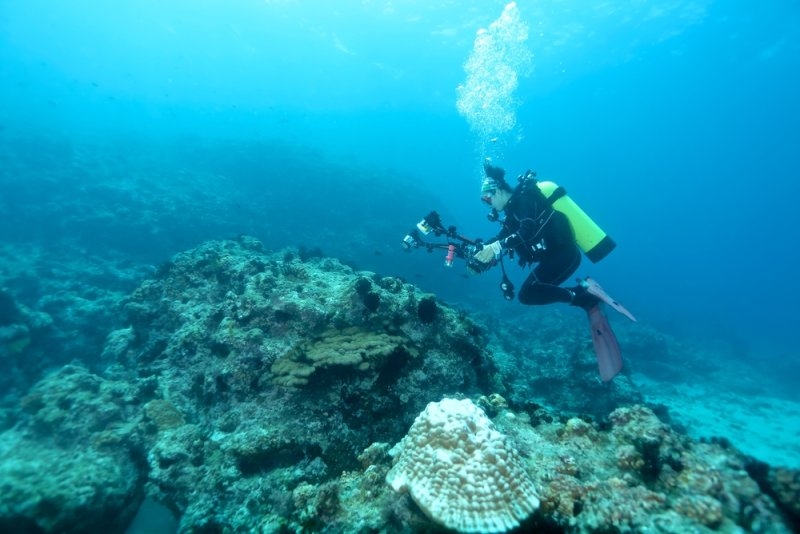
Your scuba diving BCD is essential to your buoyancy control and is what makes a more comfortable dive. It allows you to sink and rise in the water column and to rest on the surface.
Choosing a BCD is more than deciding on an expensive name brand; however, there are different BCD styles, proper-fitting BCDs, and some basic BCD maintenance to allow you to dive more comfortably.
What is a buoyancy control device (BCD)? You might also see it called a buoyancy compensator. A BCD is an inflatable vest or harness you wear that attaches to your scuba cylinder.
Simple, predictable control is the foundation of any good diving BCD. Air added to the BCD increases the lift, and air let out is used to go down or maintain depth. The BCD may be used to raise a diver at the surface, but it does not take the place of training, correct weighting, and other safety gear.
This guide will familiarise you with the different types of scuba buoyancy compensators so you can choose the one which is right for your level of experience and who you are diving with. The three types are jacket, back-inflation, and backplate-and-wing.
A jacket BCD overlaps the trunk of the body and has an air bladder encircling the sides and back. Its common vest-like appearance provides comfort and ease of use for novice divers. Several models also come with storage pockets and integrated weight systems.
A back-inflation BCD has the air bladder mostly behind the diver. It can assist in keeping you level while swimming and can help keep your chest unencumbered. Some divers find surface flotation to be a little counterintuitive and take some time getting used to.
This is a harness/backplate system with an independent inflatable wing. More modular and customisable, it can be suitable for more experienced, frequent divers who like a streamlined system, but the fitting of some parts and the harness adjustments may be a bit more challenging.
When trying to decide jacket BCD vs backplate BCD, the best option will depend on your comfort level and what you want to get out of your diving. You are more than likely comfortable with jacket versions, and yes, backplates are more customisable.
Think about these distinctions before purchasing:
A best scuba BCD is one that is a perfect fit, works well with your other gear, and is suitable for your ideal type of diving.
Getting the right fit on the scuba BCD can avoid slipping, discomfort from compression, and lack of freedom of movement. Test the BCD with your regular wetsuit, as you don't want the weight of your suit to make a difference.
Position the shoulder, waist, and chest straps so that the BCD does not constrict breathing or movement of your arms. Ensure the cylinder is secure and that the cylinder valve does not strike your head when looking up. Ensure the weight pockets and release mechanisms are accessible.
Divers should practice making the BCD do what they want with an instructor or other dive professional before they leave the surface. Practice holding the BCD while in the water to see how it responds to control inputs. The BCD should remain stable while swimming and making adjustments.
Keep up with your scuba BCD. Proper maintenance of your scuba BCD not only prevents excess damage but also keeps components functioning correctly. Failing to rinse your gear leaves water, sand, and salt in the bladder, inflator, straps, and valves.
Rinse the outside of the jacket after each dive. Rinse the bladder inside out (following the manufacturer's directions) and flush with fresh water, then drain well. Maintain an absence of grit in the inflator and avoid pulling or twisting any hoses.
Prior to stowing the BCD, it should be visually checked for cuts, leaks, faulty buckles, loose stitching, and corrosion. It should be stored in a dry, cool, well-ventilated environment, out of direct sunlight and away from excessive heat. Professional servicing should be arranged in accordance with the manufacturer's recommendations, and BCD should not be used if a leak or faulty valve is suspected until it has been checked.
The best scuba BCD will fit your diving style. Novice divers might go for straightforward controls and adjustable straps, whereas the more seasoned traveller will want a lighter BCD.
Verify the lift capacity, internal weight system, pocket design, inflator shape, and cylinder compatibility. Your BCD should be able to support your total kit, all of your gear configuration, and the diving environment. Your dive instructor or instructor can assist you in selecting these features.
Test out various BCDs prior to buying whenever attainable. A scuba BCD will almost certainly truly feel different with a wetsuit and cylinder than it does in the retailer. Seeing how it fits and performs beneath your expert supervision will prove invaluable just before open-water time.
Selecting a scuba diving BCD involves choosing based on comfort, buoyancy control, attachment points for gear, and maintenance. Decide between a jacket or back-inflation design, or perhaps a backplate style.
The best scuba BCD is the one that fits your training and diving style. Ensuring a snug fit and doing the best scuba BCD maintenance will have your gear ready for your next underwater adventure.
Yes, most BCDs are suitable for both environments. Saltwater is denser than freshwater, so you may have to rebalance your weighting. You should always check your buoyancy with an experienced instructor when you change between environments.
How long this item will last will be determined by how well it was built, stored, and cared for. There is no definite time to replace this product. It should be checked and serviced as per the manufacturer's instructions to ensure it remains safe to use.
Yes, as long as airline restrictions are followed: Empty the bladder, seat-back strap, and mount the inflator assembly, and ensure the assembly is within baggage weight limits.
False. While a BCD can be used for buoyancy compensation, the weight is still very important. Too much weight will affect your ability to control your buoyancy as well as make it more effortful to move underwater. A specialist instructor can advise.
Renting enables beginners to experiment with various styles until they settle on the one they want to buy. If you plan to go diving often, wearing a BCD that fits you will be a whole lot more comfortable. Consider your wallet and available space, and determine how often you intend to go diving.
This content was created by AI